Table of Contents
Testnet farming is the only corner of airdrop hunting where the capital requirement is genuinely zero. No bridge risk, no locked deposits, no liquidation. Just time, a wallet, and consistency.
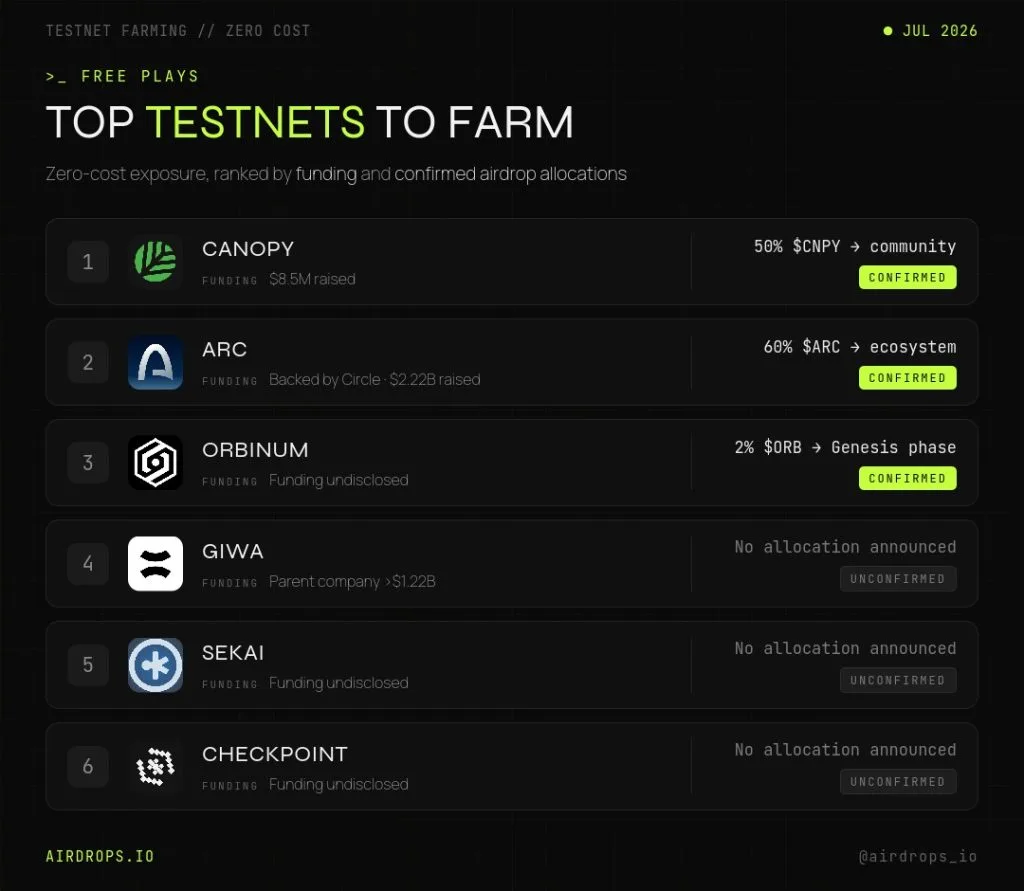
Right now the testnet field is unusually strong: one project has a confirmed airdrop with 50% of supply going to the community, another is built by the company behind $USDC, and a third comes from Korea’s biggest exchange. Here are the 6 worth farming, ranked roughly by signal strength.
1. Canopy: the confirmed one
Canopy is the anchor of this list because it’s the only confirmed drop here. It’s an appchain L1 framework that lets developers deploy sovereign Layer 1 blockchains without bridges or shared blockspace, raised $8.5M from backers including Arrington Capital and Fenbushi, and has run its public testnet since February 12, 2026.
The numbers that matter:
- 50% of $CNPY supply is allocated to community and product users, one of the largest community allocations of any live campaign
- Deploying your own testnet appchain earns the highest points multiplier in the program, and it’s free
- Daily check-ins, quests, referrals, and social tasks all count toward your allocation
- The final snapshot lands roughly 2 weeks before TGE, with mainnet targeted this year
The highest-value action, launching a testnet L1, costs nothing and signals genuine builder intent, which is exactly what the team has said it wants to reward. If you only farm one testnet from this list, this is the one.
2. GIWA: Upbit’s L2
GIWA is the Ethereum L2 built by Upbit, South Korea’s largest exchange, on the OP Stack with 1-second block times. No token has been announced, but Korea’s dominant exchange (roughly 73% of the domestic market) doesn’t build a chain for fun. Coinbase built Base, Kraken built Ink, and both ecosystems ended up rewarding early users one way or another.
The testnet has processed on the order of 100 million transactions since launching in September 2025. The farming loop is simple: claim Sepolia ETH from the faucet, bridge to GIWA Sepolia, deploy a contract, mint an NFT. Mainnet is expected sometime after the Optimism OP Enterprise deal fully lands.
Zero cost, pure speculation on Upbit rewarding early users. The precedent is on your side even if nothing is promised.
3. Arc: Circle’s L1
Arc is Circle’s institutional L1 where USDC is the gas token. The token is unconfirmed as an airdrop, but the whitepaper already lays out $ARC tokenomics with 60% of supply going to ecosystem development, and Circle completed a $222M presale at a $3B FDV. The testnet runs with 100+ institutional partners including BlackRock and Visa.
The farming loop: claim USDC and EURC from the Circle faucet, bridge, swap, LP, and deploy. One tactical note that history supports: breadth beats volume in retro drops. Touching 4+ different protocol types on a testnet has historically outperformed grinding one action repeatedly, so spread your activity across swap venues, lending, LPing, and deployment rather than looping a single swap.
The honest caveat: Circle is a NYSE-listed company, so if a token ever ships to testnet users, expect KYC or geo restrictions to come with it.
4. Orbinum: the quiet privacy play
Orbinum is a privacy L1 mixing ZK shielded pools with full EVM compatibility. It’s early and quiet, which is usually exactly when farming is cheapest: no crowd, no sybil arms race, no diluted points.
The faucet drips 10 ORB per address every 24 hours via Discord. Test shielded transfers, unshield back, and run normal EVM transactions. No airdrop is confirmed, so treat this as a low-effort daily habit rather than a conviction play. Two minutes a day, and you’re positioned if the team goes the retroactive route.
5. Sekai: liquid staking on Hyperliquid
Sekai is a liquid staking protocol on Hyperliquid where anyone can launch their own LST, with instant exit liquidity through the Sekai DEX from day one. The public testnet went live in June 2026, so you’re still genuinely early.
What to do: mint, redeem, and swap LSTs on the Sekai DEX, provide liquidity, and submit bug reports in Discord. There’s no points program yet, which is the classic early-mover setup: activity logged before a program exists tends to get counted retroactively when one launches.
6. Checkpoint: the meta play
Checkpoint is a marketplace for trading airdrop points before TGE, with escrow-backed settlement. The meta logic writes itself: farm the platform where everyone else will be trading their farms.
Earn XP through market activity and referrals on the testnet. No token confirmed. As point markets grow into their own vertical (points already trade OTC for several major farms), the platform facilitating those trades is well positioned, and early XP is the cheapest exposure to that thesis.
How to farm all 6 without burning out
Every one of these costs nothing but time, so the constraint is consistency, not capital:
- Canopy: deploy your appchain once, then daily check-ins and quests
- GIWA: one setup session (faucet, bridge, deploy, mint), then periodic activity
- Arc: one breadth session across 4+ protocol types, refreshed weekly
- Orbinum: 2-minute daily faucet claim and a shielded transfer
- Sekai: a weekly session of LST minting, swapping, and LPing
- Checkpoint: market activity as point markets interest you
Spread activity over weeks rather than blasting everything in one day. Sybil filters increasingly look at wallet age and behavioral consistency, and a wallet that shows up once and vanishes looks exactly like a farm bot.
NFA, DYOR. Only Canopy’s airdrop is confirmed. The other five may never distribute anything, and even confirmed programs can change terms before TGE. Testnet farming costs no capital, but your time has value too, so weight your effort toward the confirmed and highest-signal plays.
