

Table of Contents
The most expensive mistake in perp DEX farming is treating it like a volume contest. We ran roughly $80K of volume on a points program and walked away with more points than wallets pushing $500K+. That gap is the entire lesson. Modern points systems score the quality of your trades, not the size of your churn, and once you understand what they actually measure, you can farm harder with less capital and less risk.
This guide to perp DEX farming covers what the scoring really rewards, four hedged strategies that survive contact with a de-sybil pass, and a full tier list of where these plays are live right now.
Why volume stopped working in perp DEX farming
The old perp DEX farming loop was simple: spin as much notional as possible, top the leaderboard, collect. That era is over. Platforms watched farmers wash-trade billions in fake volume through Season 1 programs, and the newer systems are built specifically to ignore it.
Lighter is the cleanest example of where this went. Its points ran on a scoring model that weighted trade quality and open interest over raw size, and when Season 2 wrapped, the team openly clawed back and reallocated points tied to sybil and self-trading behavior. Wallets that thought they’d farmed a bag watched it get deleted. The pattern shows up across the community too: plenty of documented cases where $300K+ of volume paid out three to five times fewer points than steady, real trading on $50K to $100K.
The takeaway is blunt. If the system can tell you’re faking it, you’re not farming, you’re donating fees.
What the scoring actually rewards
Different platforms weight these differently, but the modern perp DEX farming stack tends to reward the same handful of signals:
- PnL and Sharpe-style consistency. Profitable trading is ideal, and even slightly negative real trading counts. What the models are really after is a sane risk profile over time, not a single degen jackpot. Steady beats spiky.
- Holding time. A two-minute in-and-out is worth almost nothing. Hold a position three hours or more and it starts carrying real weight. Duration is one of the cheapest signals to farm honestly.
- Open interest, not just turnover. Sitting in size (mid-range OI) tends to score better than flipping the same $1 back and forth a thousand times. CT farmers have been calling this “mid-OI farming” for a reason.
- Liquidations. On some venues, soft or partial liquidations are one of the top point triggers (more on this below). Counterintuitive, but the platforms treat it as real risk-taking.
The list of what gets filtered matters just as much for perp DEX farming: wash trading, bots, fast entries and exits, and clustered wallets. Points earned this way don’t just fail to count, they get removed retroactively once the de-sybil sweep runs. Time it wrong and you farm for weeks for zero.
Four perp DEX farming strategies that hold up
All four perp DEX farming plays are built on the same idea: keep directional risk near zero while the points accrue on the qualifying leg. Sizes below are illustrative, scale them to your own risk.
1. The small-size hedge
Open a long on the DEX you’re farming (say $1,000) and open the opposite short at the same entry on a CEX like MEXC ($1,000). Fees on both legs can be near zero, and because you’re delta-neutral, price moves don’t hurt you. The DEX leg earns points, the CEX leg cancels the risk. This is the entry-level perp DEX farming play, market exposure fully hedged out.
2. Liquidation fishing
Liquidations are one of the highest point-per-dollar triggers on venues that reward them, and platforms like Lighter run soft liquidations, closing a portion of your position (roughly 40%) rather than nuking 100%. That makes a controlled liquidation farmable. The catch is the fee.
⚠️ These days some perp DEXs charge around 1% of your position size when you get liquidated (Lighter is one of them). At 50x leverage that fee can eat more than the entire margin you put up. A liquidation is a tool here, not an accident, but 50x turns it into a fatal one. Keep leverage low and check the current fee before you try this.
3. The three-account hedge
Register three accounts (yourself plus trusted friends) and hedge between them instead of against a CEX. Long $1,000 on account one, short $350 on account two, short $650 on account three. The shorts sum to the long, so you’re flat, but the uneven, split sizing makes the hedge much harder for the protocol to fingerprint than a clean two-account mirror. You also end up with three farming positions instead of one.
Proxies and an antidetect browser are mandatory for this, and be honest with yourself about the downside: multi-accounting violates most platforms’ terms, and if the cluster is detected the points get wiped. This is the highest-reward and highest-risk play on the list.
4. The correlated-pair fork (“liquidation starter pack”)
Run a fork on two assets that move together, like $ETH and $BTC. Open a long on one and a short on the other, then set your take-profit to roughly offset what a liquidation would cost you. If a liquidation on one leg would run you about $10, set a $10 TP on the other. You close your trades at a small plus or minus while gathering more points than a plain volume grind would pay, and the correlation keeps the two legs hedged against each other. It scales cleanly across several accounts.
If manual trading isn’t your thing, the passive version of perp DEX farming is vault farming: deposit into a strategy vault that generates the qualifying activity for you. Lower ceiling, far lower effort, and no leverage decisions to fumble.
Where this works right now: the 2026 tier list 👀
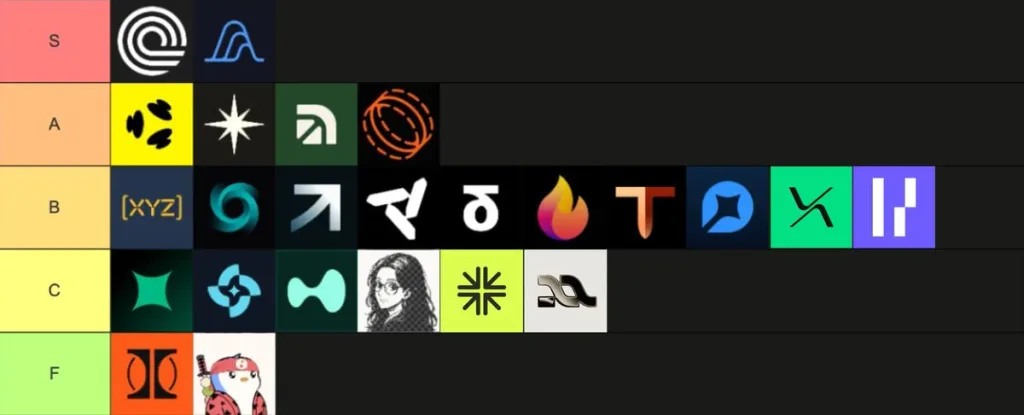
🟢 S tier
- Ondo Perps, points confirmed, very early, $24M backing. The best fresh farm on the board right now.
- Variational, $60.3M raised, highest-quality farm with strong token and community-distribution expectations. The catch: you’re boarding the last pre-TGE train, not the early one.
🔵 A tier
- Decibel, strong trader alignment with relatively limited dilution.
- Bulk, good asymmetry, just no longer uncrowded.
- Arcus, highest-upside speculative early footprint.
- Tread, better token certainty than most, but no published TGE date, supply, allocation, or guaranteed points-to-token conversion yet.
⚪ B tier
The crowded middle, where you farm selectively:
- Trade.xyz, strong product, weak farm disclosure.
- TurboFlow, better asymmetry than post-TGE Markets.xyz or Katana, but thinner transparency and less earliness than the top farms.
- Markets.xyz (by Kinetiq), a solid post-TGE rewards farm, not a fresh drop.
- Nado, strong RWA selection and boosts, but campaign age and falling emissions efficiency cut the upside for new accounts.
- StandX, built for makers more than taker-volume farmers.
- Hibachi, strong token signal, but substantial dilution.
- Tradoor, potentially stacks its points on top of other venues (kPoints, Trade.xyz activity, Extended points, speculative Hyperliquid ecosystem rewards).
- TrueNorth, good double-dip through its integrations, currently more agentic-brokerage than native DEX farm.
- Rise, early points and referral farm, but a potentially long season and the recent $673K XLP incident weaken the risk-adjusted case.
- Perpl, transparent double-dip with fixed-supply mPoints ($500K to $1M in $MON plus Perpl Points), but MON only pays after 16 weeks and native-token upside is unconfirmed.
🟡 C tier
Mature or weak asymmetry, trade if you’re already there:
- Extended (X10), strong product and backers, but the farm is mature, emissions got cut, and the delayed TGE raises the opportunity cost.
- Pacifica, good product, poor new-user asymmetry after a long emissions run.
- Hyperliquid, elite trading venue, weak current airdrop farm.
- Minara and Midas Markets, more of a double-dip interface and an ongoing trading habit than standalone perp farms.
- Brownian, fresh-farm asymmetry ($1M USDC plus confirmed Brownie Points-to-token conversion at TGE), but the rate and tokenomics are undisclosed and it’s barely battle-tested.
🔴 F tier
- Ostium, don’t deposit fresh farming capital.
- Dango, close positions and withdraw immediately.
One extra angle worth stacking on top of any of these: funding-rate arbitrage. Long the low-funding venue, short the high-funding one, and you pocket the rate differential while staying delta-neutral and earning points on both legs. Track the spreads on DefiLlama and it pairs naturally with the small-size hedge. And the reason perp DEX farming is worth the effort at all is the ceiling, the $HYPE drop reset expectations for what a well-chosen farm can pay out.
Real risks in perp DEX farming ⚠️
- Leverage can cost more than the points are worth. Farming at 1x to 2x with tight risk beats degening for points every time. High leverage plus a liquidation fee is how farmers turn a points play into a loss.
- De-sybil sweeps are real and retroactive. Lighter removed and reallocated malicious points after Season 2. Multi-account setups can be detected after the fact, and clawbacks don’t care how long you farmed.
- Terms change under you. Points programs “may adjust distributions at their discretion” is standard language, so scoring and mechanics can shift mid-season.
- Geography and ToS. Many of these venues exclude US and other restricted-region users, and multi-accounting breaks most terms of service.
Bottom line
Perp DEX farming moved from “how much can you spin” to “how real can you look.” Quality of trade, holding time, and open interest are the levers now, and the farmers getting paid are the ones running small, consistent, hedged positions instead of chasing leaderboard volume. Match the strategy to your risk appetite: the small-size hedge for calm capital, correlated-pair forks if you’re already a trader, multi-account setups only if you understand the ban risk you’re taking on.
For the venue-by-venue breakdowns and the tools that make hedged farming less painful, our perp DEX farming tools guide is the place to start, and you can track live points programs in our airdrop database.
NFA, DYOR. Leveraged trading carries liquidation risk and can lose more than your margin. Multi-account farming violates most platform terms of service, and points earned through hedging or sybil-adjacent activity can be removed retroactively. Many perp DEXs are unavailable to US and other restricted-region users. Only trade what you can afford to lose.
